Gear Guides - Tennis Racquets
How to Measure Your Tennis Grip Size
If you’re like most Tennis Warehouse customers, you already have an idea of the type of racquet you’re seeking. You want to upgrade from your current racquet - maybe you’re seeking more power, more control, more comfort... or a little of all three. Whatever your reason(s) for purchasing a new racquet, you have some basis on which to make your decision.
Then again, you may not have a clue as to which racquet is best for you and are simply motivated by a review you read. Add to the confusion the shear amount of racquets available and choosing the right racquet becomes pretty daunting! To make this process a little easier, here’s a primer on racquet characteristics and how they affect performance. We also suggest you read our racquet reviews where you’ll find detailed information from real tennis players on how a specific racquet performs on-court. Our Racquet Technologies section includes explanations and illustrations of racquet technologies and materials, such as nCode, Hot Melt, Liquidmetal, and F.I.R.E., to name a few. Finally, our General Racquet & String Terms provide definitions of terms that are used throughout our website to describe racquet and string performance.
Today, there are 3 major racquet categories, with several subcategories. They are:
 This is the term used by racquet manufacturers for power-oriented racquets. In most cases, these racquet models feature oversize to super-oversize heads (107-135 square inches), are lightweight (8-9.5 ounces), longer (27-29 inches) stiffer and are balanced head-heavy (or evenly balanced) to retain enough weight in the hitting zone. Designed for players with shorter, slower swings and who want more power from the racquet. Here are some of the top game improvement racquets:
| Select Game Improvement Racquets | |
|---|---|
 Asics 125 Racquets Offering major comfort and impressive power, this super oversize racquet delivers a great combination of speed and stability. Headsize: 125 in². Length: 27.5 in. Strung weight: 9.6 oz. Price: $169.00, Customer Feedback, |
 Dunlop Biomimetic S8.0 Lite Racquet An extended length racquet offering maximum comfort and power, this is ideal for players with compact strokes. Offers a forgiving feel with some serious pop. Headsize: 115 in². Length: 27.5 inches. Price: $149.00, Customer Feedback, |
 Head Graphene Prestige PWR Racquet The iconic Prestige series adds a very maneuverable oversize racquet to the line. This extended length racquet is packed with power, comfort, and spin. Ideal for players with compact to medium strokes. Length: 27.3 inches. Headsize: 107 in². Strung weight: 9.7 ounces. Price: $179.95, Customer Feedback, |
 Prince Premier 115L ESP Racquets Big on comfort, this one is ideal for beginners and intermediates looking for a smooth ride along with all the power and spin they will ever need. String Pattern: 14x16. Headsize: 115 in². Standard length. Price: $169.00, Customer Feedback, |
 ProKennex Ionic Ki 30 Racquets The most powerful Ki racquet, the Ki 30 is a good fit for beginners to intermediate players who also seek comfort and maneuverability. Headsize: 117 in². Length: 27.5". Strung weight: 9.6 oz. Price: $179.99, Customer Feedback, |
 Volkl Organix 1 Racquets Players who want to get more power from their compact strokes have come to right place! This extended length racquet is loaded with pop and comfort. Length: 27.8 inches. Headsize: 115 in². Strung weight: 9.9 oz. Price: $179.99, Customer Feedback, |
 Wilson K Factor KZero Racquets A great choice for beginners seeking a game improvement racquet. The KZero is the lightest racquet in the K Factor line. Impressive power and control. Super oversize head: 118 in². Length: 27.5 inches. Price: $99.00, Customer Feedback, |
|
 There are several models that offer a blend of features from game improvement and player’s racquets. They are often light-er (9.5-11 ounces), balanced anywhere from slightly head-light to slightly head-heavy and have midplus (95-102 square inches) heads. These racquet models offer low-medium to medium-high power and are most appealing to intermediate-advanced players, seeking enhanced maneuverability. Here are some of the top 'tweener racquets:
| Select Tweener Racquets | |
|---|---|
 Babolat AeroPro Drive Racquets Endorsed by Rafael Nadal, the AeroPro Drive offers a truly exceptional blend of maneuverability, stability and all- around playability. Strung weight: 11.3 oz.. Headsize: 100 in². Price: $199.00, Review, Customer Feedback, |
 Babolat Pure Drive Roddick Plus 2013 Racquets This racquet provides huge power and spin from all areas of the court while offering improved comfort and feel over the lighter Pure Drive Plus. Strung weight: 11.8 oz. Swingweight: 336 RDC. Balance: 6 pts head light. Price: $129.00, Review, Customer Feedback, |
 One Strings Spin Deeper 315g Racquet 14x19 A TW Exclusive! Big spin and plenty of power wrapped in a comfortably crisp response. This is a great option for 4.0+ players looking to impose their will from all areas of the court. String Pattern: 14x19! Headsize: 100 in². Strung Weight: 11.6 oz. Length: 27.1" Price: $189.00, Review, Customer Feedback, |
 Prince Warrior 100 ESP Racquets Offering truly exceptional spin with a nice balance of power and control, this one is ideal for players in search of a maneuverable weapon that plays well from all areas of the court. Head size: 100 in². String pattern: 14x16. Standard Length. Price: $149.00, Review, Customer Feedback, |
 Volkl Super G 8 (300g) Racquets A very versatile racquet that works just as well for the aggressive topspin player as it does for the consistent grinder. A great option for 4.0+ players looking for a great combination of precision, spin, and pop. Headsize: 100 in². Strung Weight: 11 oz. Standard Length. Price: $179.99, Review, Customer Feedback, |
 Wilson Juice 100S Spin Racquet The Juice 100S is a dangerous weapon in the hands of any player who likes hitting powerful, spin loaded balls. Depth comes easy with this one. String Pattern: 16x15. Headsize: 100 in². Strung Weight: 11.2oz. Price: $199.00, Review, Customer Feedback, |
 Yonex EZONE Ai 100 Racquets This one is packed with crisp precision and some serious spin potential. Updated with New Isometric technology for even more comfort. Headsize: 100 in². Strung Weight: 11.2 oz. String Pattern: 16x19. Price: $199.00, Review, Customer Feedback, |
|
 Denotes racquets that would be used by professional and high-level club and college team players. These models are typically heavier in weight (11.5-13+ ounces), have smaller heads (85-98), thinner, more flexible beams and are balanced head light to retain maneuverability. The result is a low-power racquet, designed for players who provide their own power and prefer a racquet that offers more control. Can be standard or extended length. Here are some of top player's racquets:
| Select Player's Racquets | |
|---|---|
 Babolat Pure Control Tour Racquets An impressive combination of speed, stability and control. A nice option for the 4.5+ player who places a premium on feel. There's also plenty of spin available. String Pattern: 16x20. Strung Weight: 11.8. Standard Length. Price: $159.00, Review, Customer Feedback, |
 Babolat Pure Strike Tour Racquets This is a solid option for strong intermediates and advanced players looking for stability, precision and feel. Perfect for trading heavy balls. Phenomenal directional control. String Pattern: 18x20. Strung Weight: 12oz. Standard Length. Price: $159.00, Review, Customer Feedback, |
 Dunlop Biomimetic F2.0 Tour Racquet A great option for strong players in search of precision and feel. Offers a nice combination of speed and stability with decent power for a player's racquet. Headsize: 95 in². String Pattern: 18x20. Strung weight: 12 oz. Price: $89.00, Review, Customer Feedback, |
 Head Graphene Speed Pro Racquets This racquet provides the ingredients necessary for aggressive tennis and controlled shot making. A maneuverable player's racquet that delivers maximum precision. Strung weight: 11.7oz. Standard length. Headsize: 100 in². Price: $129.95, Review, Customer Feedback, |
 Prince Classic Graphite 100 Racquets FINALLY! Prince puts its Original Graphite recipe into a standard length midplus package. Offering absolutely amazing feel and precision, this 100% graphite racquet is 100% classic. Headsize: 100 in². Standard Length. Strung Weight: 11.7 oz. Price: $159.00, Review, Customer Feedback, |
 Volkl Power Bridge 10 Mid Racquets Updated with a black cosmetic, this impressive player's frame is loaded with feel and control. The open string pattern offers excellent access to spin and ample pace that results in a heavy ball. Headsize: 93 in². Standard length. Beam width: 19mm. Price: $159.99, Review, Customer Feedback, |
 Wilson Six.One 95 (16x18) Racquets Precision, plow through and feel combine to make this classic a great option for advanced players. Featuring an ultra head light balance, this one accelerates rapidly and provides great all court performance: String Pattern:16x18. Headsize: 95 in². Balance: 10pts HL. Price: $139.00, Review, Customer Feedback, |
 Yonex VCORE Tour G 330 (Wawrinka) Racquets The racquet of choice by Grand Slam champion Stanislas Wawrinka! This one is solid as a rock and delivers exceptional control. There's also plenty of pop and spin available to those who can swing it. Headsize: 97 in². Strung Weight: 12.2 oz. Standard Length. Price: $199.00, Review, Customer Feedback, |
 Power is directly related to head size - a larger head will provide more power than a smaller head, all other things being equal. A larger head also offers a larger hitting area and sweetspot, providing more forgiveness on off-center hits. Today’s racquets are offered in head sizes ranging from 85 to 135 square inches, with the most common being 95-110. These head sizes offer a compromise between power and control for many players. Generally speaking, a smaller racquet head appeals to more accomplished players seeking more control, while larger racquets appeal to beginning and intermediate players seeking more power and a larger sweetspot.
 Racquets are available in lengths ranging from 27-29 inches, the legal limit for tournament play. Standard racquets are 27 inches long. A longer racquet provides more reach on groundstrokes, added leverage on serves and slightly more power overall than standard length racquets, all other things being equal. For most players, switching from a standard length racquet to one that is 1/2 -1 inch longer doesn’t normally present much of a problem. Most (but not all) longer racquets are lighter than their standard-length counterparts to keep them maneuverable. As racquet length increases, so does dynamic swingweight. Simply lengthening a 27 inch racquet without reducing weight would result in a very unwieldy “club”.
 These two characteristics most influence how a racquet feels when you pick it up and when you swing it on the tennis court. Some basic concepts - a heavy racquet is more powerful, more stable and transmits less shock than a lighter racquet (all other things being equal). A lighter racquet is more maneuverable and thus, a player is able to swing it faster. If this is true, won’t a lighter racquet that is swung fast generate the same power as a heavier racquet that’s swung more slowly? This question has been hotly debated ever since Wilson introduced their Hammer racquets back in 1990. Until then, racquet weights averaged 12-13 ounces and were balanced head light (or handle heavy). Wilson’s Hammer “technology” reduced overall racquet weight (10-11 ounces) but distributed more mass in the head, resulting in a head-heavy balance. The idea was to improve maneuverability without sacrificing power by keeping weight in the racquet’s hitting zone. Since then, racquet weights have steadily dropped and now we have sub-10 ounce offerings from most manufacturers. Is lighter better? Not necessarily. Well then, which racquet weight is best for you? What about racquet balance? Is head-light, head-heavy or even balance best? In order to answer this question, you need a point of reference. How heavy is your current racquet? Is it head light or head-heavy? How much? If you don’t know, you can e-mail us at info@tennis-warehouse.com and we’ll send you the manufacturer’s specifications, if available.
Next, do you want a lighter, heavier or similarly weighted racquet? Head-light, head-heavy or evenly balanced? Chances are you don’t know what you want until you play with a racquet. If this isn’t feasible, here are some guidelines on the advantages and disadvantages of different weights and balances.
Heavier, head-light racquets- preferred by most professional players, these racquets are often referred to as being “traditionally weighted and balanced” racquets. They typically weigh 11-13 ounces and are balanced 1/2 to 1-1/2 inches head light in order to retain maneuverability. In most cases, these racquets are also referred to as “player’s” racquets because they are generally more control-oriented and designed for players who provide their own power.
Lightweight, head-heavy racquets - several years ago, Wilson discovered it was possible to make a racquet more maneuverable without reducing weight in the head. By removing weight in the handle, the racquet was lighter overall, while still retaining mass in the upper hoop, where ball contact occurs. This was the concept behind their Hammer and Sledge Hammer designs. Several other racquet manufacturers have subsequently introduced lightweight, head-heavy (and evenly balanced) racquets. The advantages of this racquet type are increased maneuverability without sacrificing power, especially on groundstrokes. The disadvantages are less clear - some “experts” argue that reducing weight increases the amount of shock transferred to the wrist, elbow and shoulder. Some players who have switched from traditionally weighted and balanced racquets to lightweight, head-heavy models claim the racquets don’t feel “solid”. Clearly, you can’t get something for nothing. Reducing racquet weight will alter its feel - for better or for worse. Keep in mind, you can always add weight to a racquet if it’s too light. Reducing racquet weight, however, is almost impossible.
 The amount a frame deflects during ball contact directly affects its power potential. A stiffer racquet bends less, thus depleting less energy from the ball. A flexible racquet bends more, resulting in more energy loss. A common myth among players is that a flexible racquet, that bends back more, returns more power to the ball due to a catapult-effect. The ball remains on the strings for 3-5 milliseconds, much shorter than it takes a frame to recover. Consequently, a racquet frame doesn’t “return” energy to the ball, it absorbs energy - either more or less, depending on stiffness. Stiffer racquets don’t deflect as much on impact, resulting in less power drain than a flexible racquet.
Frame stiffness doesn’t only affect power though. Control and comfort are also at stake. Generally speaking, a racquet that offers more power provides less control. However, this is largely dependent on player type and ability. An advanced player may prefer a flexible racquet because he or she has a long, fast swing and provides plenty of power. A stiff racquet might be too powerful for this player, resulting in too many balls landing long. A beginning or intermediate player though, may find a stiffer racquet that doesn’t deflect as much on impact, provides better control. This may also apply to a more advanced player with short, compact strokes. To a certain point, stiffer racquets are generally less comfortable than more flexible racquets. A very stiff frame will transmit more impact shock to the wrist, elbow and shoulder than a medium stiff frame. Comfort is difficult to measure - each player has a different perception of what feels comfortable. However, players with arm and/or shoulder problems will generally benefit more from a flexible to medium-stiff frame and should likely avoid stiff or very stiff frames. A lesser known effect of frame stiffness is the amount of spin that can be generated. Generally speaking, stiffer racquets provide less spin than flexible racquets because the ball leaves the stringbed more quickly.
 Often overlooked by many recreational players, string pattern density influences many aspects of a racquet’s overall performance and feel. When we discuss string pattern density, we refer to open and dense (or closed).
An open string pattern will deflect more on impact than a denser pattern, providing greater ball rebound. Strung at the same tension (in similar racquets) an open string pattern won’t feel as “tight” as a dense string pattern. Open string patterns also allow for more spin potential, as the ball can embed itself into the strings more, due to their wider spacing. Players seeking more spin will benefit from a more open string pattern. The price one may pay for this, though, is reduced string durability. Open string patterns allow the strings to move more freely, increasing abrasion which causes string breakage.
A denser string pattern won’t deflect as much upon ball impact, resulting in less rebound energy. More closely spaced strings will also offer less spin potential but will last longer than a similar racquet featuring a more open string pattern. Players who don’t hit with much spin and are seeking enhanced control will generally prefer racquets with denser string patterns, as will hard-hitting topspin players seeking increased string durability.
To begin breaking down the vast selection of tennis racquets on the market, we'll divide them into four primary categories: power, tweener and modern player's and traditonal player's racquets. We'll dive into each of these categories below.
This is the term used by racquet manufacturers for power-oriented racquets. In most cases, these racquet models feature oversize to super-oversize heads (107-135 square inches), are lightweight (8-9.5 ounces), longer (27-29 inches) stiffer and are balanced head heavy (or evenly balanced) to retain enough weight in the hitting zone. Designed for players with shorter, slower swings who want more power from the racquet.
Originally getting its name as a category of racquets sitting (be)tween power racquets and player's racquets, tweeners have become the most popular type of racquet Tennis Warehouse offers. A tweener borrows some of the lightness and power of the power racquets and mixes it with some of the control of the player's racquets. These racquets are often light to medium weight (9.5-11 ounces), balanced anywhere from slightly head light to slightly head heavy and have midplus (98-104 square inches) heads.
The power level typically ranges from low-medium to medium-high power, making them most appealing to intermediate through advanced players. Tweener racquets tend to be very spin-friendly thanks to possessing a light and fast feel combined with a healthy midplus headsize.
The move to a heavy topspin playing style at the top of the game has created the modern player's racquet. These racquets are lighter and faster than traditional player's racquets and offer midplus headsizes. Modern player's racquets are perfect for attacking the ball at an aggressive angle for maximum spin. The power level is similar (if not identical) to tweener racquets, and the strung weight typically falls between 11-12 ounces. Headsizes of modern player's racquets are often right around 98-100 square inches.
This category denotes racquets that would be used by professionals, high-level club and college team players. These models are typically heavier in weight (11.5-12+ ounces), have smaller heads (85-98), thinner, more flexible beams and are balanced head light to retain maneuverability. The result is a low-power racquet, designed for players who provide their own power and prefer a racquet that offers control. Most player's racquets are standard length but there are a few extended length options.
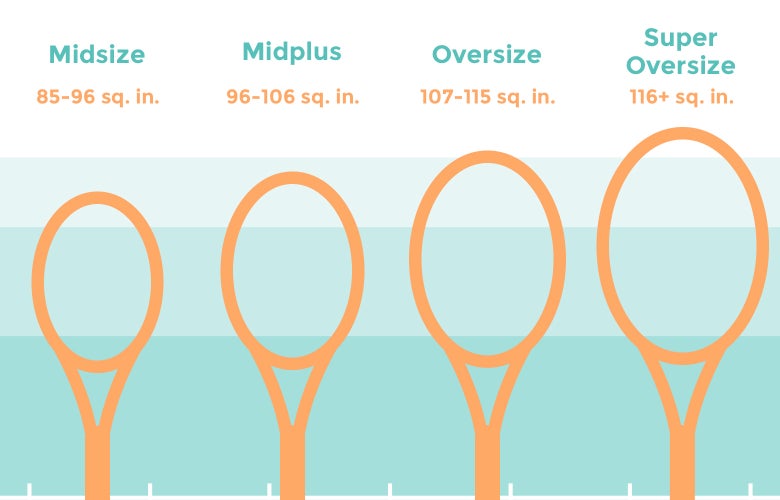
Historically, racquet head sizes have been categorized as midsize (85 to 96 square inches), midplus (96 to 106 square inches), oversize (107 to 115 square inches) and super oversize (116 square inches and larger.)
Power is directly related to head size; a larger head will provide more power than a smaller head, all other things being equal. A larger head also offers a larger hitting area and sweetspot, which results in more forgiveness on off-center hits.
Today’s racquets are offered in head sizes ranging from 93 to 135 square inches, with the most common being 97-100. Racquets at, or close to, 100 square inches offer a solid blend of power and control for many players. Generally speaking, a smaller racquet head appeals to more accomplished players seeking more control, while larger racquets appeal to beginning and intermediate players seeking more power and a larger sweetspot.
The standard length for an adult tennis racquet is 27 inches, but racquets are available in lengths ranging from 26.5 to 29 inches (29 inches is the legal maximum for tournament play). A longer racquet provides more reach on groundstrokes, added leverage on serves and slightly more power overall than standard length racquets; all other things being equal. The added length of longer racquets results in a higher swingweight, which means a little more effort is required to maneuver the racquet. Many power racquets are lighter to keep them maneuverable even at longer lengths.
These two characteristics most influence how a racquet feels when you pick it up and when you swing it on the tennis court.
Weight: A heavy racquet is more powerful, more stable and transmits less shock than a lighter racquet (all other things being equal). The extra weight of a heavy racquet helps it win the battle at contact when the stringbed collides with the ball. The result is a stable feel and the sense the racquet is plowing through the ball. We often refer to racquets with these favorable qualities as having "good plow through" in our product descriptions and reviews. From the baseline players with long fast strokes will find good depth and pace from heavier racquets. At net and on service returns the added stability is a nice benefit. Conversely, a lighter racquet is more maneuverable, and thus, a player is able to position the racquet easier and generate lots of spin (thanks to the easier access to a faster swing). On court players can whip the ball with spin to help generate better angles, get lobs and passing shots to quickly dip inside the lines and maneuver the racquet easily during quick exchanges at net. Keep in mind, you can always add weight to a racquet if it’s too light. Reducing racquet weight, however, is almost impossible.
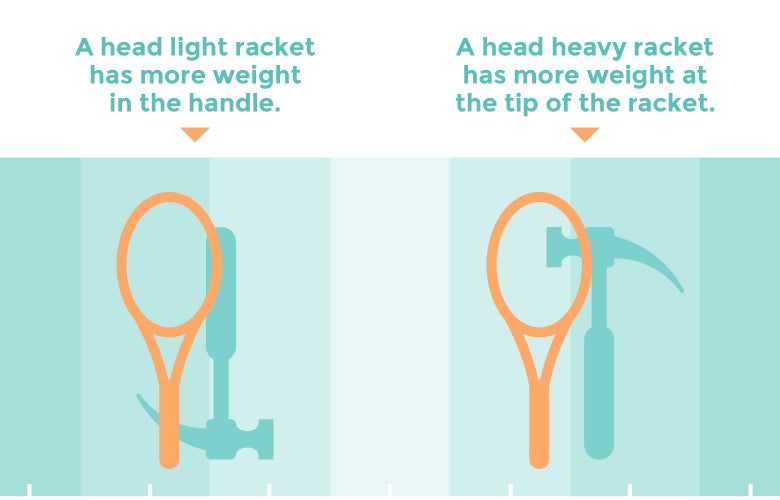
Balance: A racquet can be one of three things when it comes to balance: head light, head heavy or even balanced. A head-light racquet will have more of its mass located toward the handle end of the racquet, whereas a head heavy racquet has more weight at the tip of the racquet.
Most traditional player's racquets are head light to help keep them feeling maneuverable even though they are the heaviest type of racquet. Lightweight power racquets tend to be head heavy. With plenty of mass located toward the head of the racquet, some stability is retained despite the racquet having a light overall weight. We are then left with the medium weight racquets, which come in at an even balance or close to it. When the mass is distributed evenly throughout the racquet a blend of stability and maneuverability can be achieved without making the racquet too heavy or too light.
We measure frame stiffness and give each frame a score (RA). You will see the RA in the spec tables on our racquet description pages. Here's a general breakdown of how to decode the measurements:
Flexible frame = 63 and below
Medium stiffness = 64 to 67
Stiff frame = 68 and above
The amount a frame deflects during ball contact directly affects its power potential. A stiffer racquet bends less, thus depleting less energy from the ball. A flexible racquet bends more, resulting in more energy loss. A common myth among players is that a flexible racquet, that bends back more, returns more power to the ball due to a catapult-effect. The ball remains on the strings for 3-5 milliseconds, much shorter than it takes a frame to recover. Consequently, a racquet frame doesn’t "return" energy to the ball, it absorbs energy - either more or less, depending on stiffness. Stiffer racquets don’t deflect as much on impact, resulting in less power drain than a flexible racquet.
Frame stiffness doesn’t only affect power. Control and comfort are at stake. Generally speaking, a racquet that offers more power provides less control. However, this is largely dependent on player type, ability and the type of string installed in the racquet.
An advanced player may prefer the feel and control of a flexible racquet because he or she has a long, fast swing and provides his or her own power. A beginning or intermediate player, though, may prefer a stiffer racquet for a better blend of control and power for his or her stroke style. Many advanced players also like a stiffer and more powerful frame when combined with a stiffer and control-oriented string. The result allows the advanced player to hit with lots of power and spin. The combination of a powerful racquet with a stiff and spin-friendly string has come to define the modern power game at the elite level. However, a stiff racquet combined with a stiff string can result in comfort issues for amateur players.
To a certain point, stiffer racquets are generally less comfortable than more flexible racquets. A very stiff frame will transmit more impact shock to the wrist, elbow and shoulder than a medium stiff frame. Comfort is difficult to measure - each player has a different perception of what feels comfortable. However, players with arm and/or shoulder problems should look at frames with an RA of 66 or less.
Swingweight is a measurement of how heavy a racquet feels when you swing it. Racquets with higher swingweights are harder to swing, but they offer more comfort, power and stability at impact. Racquets with lower swingweights are easier to swing, but they offer less stability and comfort, especially when playing aganst higher levels of pace.
Advanced players prefer higher swingweights because it helps them redirect the pace of big hitting opponents. It also enables them to hit with high levels of power. Beginner and intermediate players prefer a lower swingweight because it gives them easier acceleration, which not only helps them position the racquet effectively, but it also makes it easier for them to generate the higher stroke speed required for effective pace and spin.
Low swingweight = 305 and below (Maneuverable, suitable for beginners)
Medium swingweight = 310 to 325 (Moderate maneuverability and stability, suitable for all ability levels, but ideal for intermediates)
High Swingweight = 325 and above (Very stable, suitable for advanced players)
Often overlooked by many recreational players, the string pattern of a racquet influences many aspects of its overall performance and feel. String patterns are often described as open or closed. Put simply, an open string pattern means that there are fewer mains and crosses in the racquet, and a tighter string pattern has more mains and crosses. The spacing between strings in an open pattern is bigger and smaller in tighter string patterns.
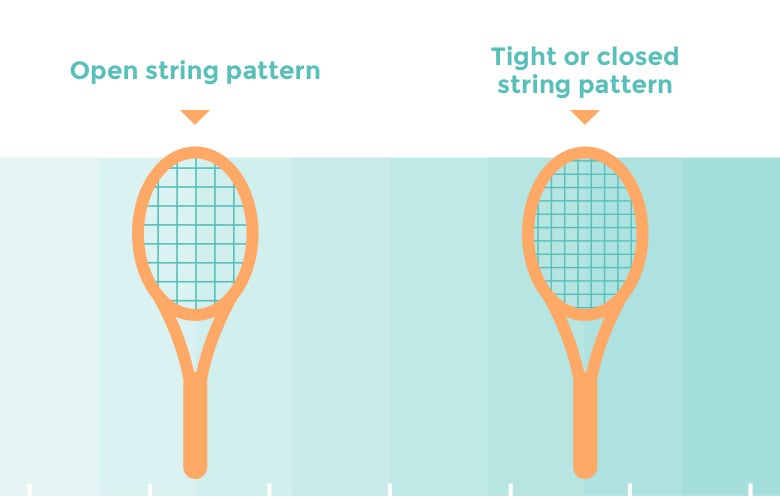
An open string pattern will deflect more on impact than a denser pattern, providing greater ball rebound and a higher launch angle. Strung at the same tension (in similar racquets) an open string pattern should feel livelier. In other words, a player will find easier access to depth and pace. Open string patterns also allow the main strings to deflect more and with certain string types the main strings will snap back into position providing more spin. The price one may pay for this, though, is reduced string durability. The increase in string movement results in more abrasion which can cause faster string breakage.
A closed string pattern won’t deflect as much upon ball impact, resulting in less rebound energy. Many players find the response of a closed pattern to offer a more controlled feel. While the stringbed doesn't allow for as much string movement for spin generation, the added control of the closed pattern allows players to swing quickly and therefore the ability to get the ball spinning quickly. More closely spaced strings can last longer and that allows the player to utilize softer, thinner and more feel oriented strings without sacrificing too much durability.