ProKennex Ki Q+ 5 Pro (310g) Racquet Review
Summary
Known for creating comfortable racquets, ProKennex offers up the Ki Q+ 5 Pro (310g) for those looking for the brand's signature arm-friendly feel in an advanced player's spec. The updated Ki Q+ 5 Pro is now slightly more maneuverable after its unstrung weight was reduced to 310 grams from 315 on the previous version. Otherwise the racquet retains the same 22-mm constant beam, 16x20 string pattern and 100-square-inch hoop. On average, our strung specs for this racquet came in at 66 for the RA, 332 for swingweight and 7-points head light for the balance. Our playtesters were quite pleased by the overall performance of this Ki Q+ 5 Pro (310g), and they praised its stability, comfort and plow through. Although individual nitpicks varied, there were no glaring universal dislikes. While this is a subtle update, it is a good one. Fans of comfort-first frames that don't want to sacrifice performance capabilities should seriously consider this hidden gem.
- Stable without feeling unwieldy
- Good power-to-control ratio
- No universal dislikes
Final Verdict
Breakdown
Groundstrokes: 8.4
When it was time to trade groundstrokes from the baseline, our team was quick to pick up on the Ki Q+ 5 Pro (310g)'s stable nature, but there was also good power and spin access. Although the over-arching theme remained the racquet's plushness, the performance of the racquet proved more than up to scratch. The Ki Q+ 5 Pro (310g) offered good depth and directional control to Mark’s game. He explained, "All in all, the new Pro Kennex Ki Q+ 5 Pro complemented my baseline game. I noticed some instability at times, or the racquet getting pushed around at the baseline, and although most of the time I didn't have any issues, there were some instances when I struggled to get the racquet around quickly. However, even without a ton of player effort, the Ki Q+ 5 Pro consistently produced a heavy groundstroke ball. The heft, combined with the firm layup of graphite, made my groundstroke depth and direction easy to manage. Additionally, the semi-tight 16x20 pattern was spin-friendly when I was hitting with topspin off either wing or slicing my backhand."
Munish found the Ki Q+ 5 Pro to be reliably precise, which let him hit his spots effectively with both depth and spin. He noted, "This racquet felt maneuverable, and I felt like I was getting a great arc on my forehand. I was quite surprised to see that my spin numbers weren't as high because I genuinely thought I was ripping through the balls. I did also love it on my backhand, but more for the stability and plow through it added to my one-handed backhand. The hoop of the frame felt stiff, and I think that's where the power came from, while the yoke felt like it had a bit more give to it. I definitely think the Ki q+ 5 Pro (310g) suited my game at the moment. I have been going through a bit of tennis elbow, and it's been a nightmare to play tennis, but my elbow was perfectly fine with the ProKennex Ki Q+ 5 Pro.”

Long a fan of the previous Ki Q+ 5 series, Oak praised the Ki Q+ 5 Pro (310g) for its improved handling and its ability to hit stunning line drives from the baseline. He said, "Oh where to begin? This is a racquet family that I have a lot of affinity for, so my perspective is coming from extensive hours with the previous generation Ki Q+ 5 Pro, the Ki Q+ 5X Pro, and my personal favorite, the Ki Q+ 5. I've always said ProKennex frames tend to shine (for me) when their static weight is a little bit lower because it feels easier to take advantage of the racquet’s secondary acceleration source. With this in mind, the standard 300 gram Ki Q+ 5 has always been my favorite option within this family. The Ki Q+ 5 Pro (310g) is an improvement, though some of the racquet's inherent heft and mass-based power is lessened. That said, taking advantage of the movable mass within the frame is now slightly easier. My shots off either wing felt limited slightly, and I really needed to be intentional about adding topspin, otherwise they tended to fly long on me. That said, when you do make good contact, it rifles off line drives with devastating impact. The only trouble being the fact that it is relatively hard to discern how to get good contact with this racquet in hand. When it works, it's a dream! But getting it to work can be a frustrating experience. Topspin access is surprisingly great, and that was something I felt I could trust at all times with the Ki Q+ 5 Pro (310g)."
Troy also found the Ki Q+ 5 Pro (310g) to be dependably stable, and he was appreciative of the inherent plow through he was getting. He said, "I loved how solid and stable this racquet felt, and I really noticed the high level of plow through. Was this racquet super maneuverable or whippy, as we like to say? Not so much, but for me the plow through on flatter strokes was really nice. It felt great when I hit slices, and I absolutely loved it on the two-handed backhand drive. So in terms of just lining up the racquet and ripping a hard flat shot from the baseline, this racquet felt great. When it came to whipping up some angles or hitting forehands on the run, this racquet wasn't making things all that easy. I would say overall, though, I could play pretty solid tennis from the baseline with this racquet."
Volleys: 8.5
While at the net, the Ki Q+ 5 Pro (310g) dazzled our team with its ultra-stable nature and its ability to absorb oncoming pace with ease. Although it wasn't the most maneuverable frame at times, its stability and dwell time helped to make up the difference. Ever the craftsman at the net, Troy noted a drop-off in the racquet's handling, but he found enough stability to let the racquet do the talking. He said, "As I expressed in the groundstrokes section, I wouldn't say this racquet was all that great in terms of maneuverability. It has a high swingweight, and it felt a bit clubby when trying to have fast hands at the net. However, most of the time on my volleys I just needed to keep the racquet out in front and block the ball back, and this racquet was great at that. It felt nice and solid, and it could redirect the pace well. I felt pretty competent volleying with this racquet, but I would say the downside was trying to manipulate the racquet head when I was in a defensive position or on the stretch. The Ki Q+ 5 Pro (310g)’s balance made those little flickers when reacting quickly in doubles a little more difficult."
"The Ki Q+ 5 Pro (310g) was extremely adept at shaping shots with heavy spin, and I was able easily place touch and drop volleys on a dime."
Oak had an entirely favorable experience volleying with the Ki Q+ 5 Pro (310g) despite the decreased quickness through the air. He said, “The Ki Q+ 5 Pro was excellent at the net! I really thought this racquet volleyed quite well, and I was extra appreciative of the comfort that came from it absorbing pace. Although the racquet isn't the fastest to work with, I didn't find it too cumbersome when it came to executing volleys. I felt mostly connected to the ball, and in particular I felt very in tune with picking up lower volleys at my feet. On stretch volleys, the racquet did a fairly decent job of bringing the ball back into play."
His experiences at the net proved to be the highlight of the playtest for Munish. He explained, "I think the Ki Q+ 5 Pro (310g) shone the most at net. I felt like it was doing a lot of the work, and I was just helping with directing. It was a bit tough to maneuver the racquet at first, but I was able to figure it out eventually. Early preparation was the key for me to volley with this racquet effectively. I was able to hit through the court quite easily, so I never tried to be too crafty or angular with shots. The balls coming off my racquet were fast, low and on target, which I was quite happy with."

Mark appreciated the racquet's forgiving and accommodating nature at net, which gave him good results even when his contact wasn't the best. He noted, "At net, the Ki Q+ 5 Pro (310g) was versatile, and it felt close to neutral with a slight lean toward being responsive. With all the technologies ProKennex packs into this frame, it is hard for me to put my finger on precisely why, but I felt like the dwell time was substantial, and as a result my volleys were pretty reliable and effective. The hefty static weight and swingweight was ideal for hitting offensive volleys or defending hard passing shots, and this racquet was equally adept when it came to sponging up the pace of a half volley, even if ball contact was a bit off center!"
Serves: 8.5
Serving proved to be another area where the Ki Q+ 5 Pro (310g) may exceed expectations. Its rock-solid nature made blasting away on first serves highly effective. Even though Mark wasn't topping out in terms of pace, he could still serve well enough to stay off the defensive when starting off a point. He said, "I wasn’t able to generate tons of tip speed on my serve, but my serves had enough weight and spin to prevent my opponent's from hitting too many offensive returns. For whatever reason, I was most successful aiming first and second serves anywhere to the ad side and down the middle on the deuce side.”
"I was able to dominate points from the get-go and very rarely get into rallies, which was a good thing."
Despite not having the same access to his kick serves, Munish thoroughly enjoyed serving with the Ki Q+ 5 Pro (310g). He could hit his spots effectively and stay aggressive from the get-go. He said, "I really liked the Ki Q+ 5 Pro (310g) on serves. I was able to hit my spots and add a lot of pace on my shots. My favorite serve to hit with the Ki Q+ 5 Pro was the flat 'T' serve from the ad side, but I wasn't hitting many kick serves because I struggled with generating racquet head speed. Serving is one of the shots that I think should be credited to the weight and plow through of the racquet over the in-built tech."
Oak found the Ki Q+ 5 Pro (310g) to be phenomenal on serve. He said, "Serves with this Ki Q+ 5 Pro felt like a hammer. I loved the way this frame handled through the air above my shoulder. This was an instance where I felt fully able to get the movable mass to work with me instead of against me. Spin-heavy serves felt well within my wheelhouse, and I loved upping the pace because I felt confident the ball would drop back down accordingly. Comfort was exceptional, and let me feel confident upping the ante, knowing that I wouldn't be aggravating my arm or shoulder. My favorite serves were my flat serve up the T on the deuce side and my spin-heavy serve out wide on the ad side.”
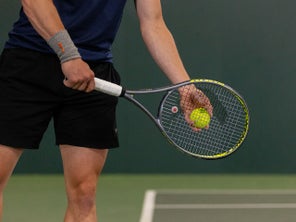
Although he didn't find the Ki Q+ 5 Pro (310g) as conducive for spin-based serves, Troy still appreciated how big he could go on his first serves. He explained, "The mass of the Ki Q+ 5 Pro (310g), combined with the 330-plus swingweight, made me feel like I could go big on my flat first serves. There was easy plow through, and it felt like this racquet was pancaking the ball when I went for a flat first serve. The Ki Q+ 5 Pro may not be the stiffest or liveliest feeling racquet, but that plow through sort of gave me the sense that my serves were coming off this racquet with good pace and weight. I felt like there was decent control, maybe not the most precision, but my placement was pretty good. The downside was that it felt like I had to work harder to generate spin and kick. I was able to hit my slice and kick serves, but it just felt like it was a bit more difficult at times."
Returns: 8.3
Our playtesters enjoyed the Ki Q+ 5 Pro (310g)’s stable nature when it was time to absorb the pace of a heavier serve. Although the maneuverability of the racquet took a hit in this area, the stability worked well for redirecting pace back to the server. Such was the case for Troy, who reveled in the Ki Q+ 5 Pro's ability to absorb and redirect pace with ease. He explained, "Hitting returns with this racquet was likely my favorite part of the playtest. When I face high level servers I keep things nice and compact and try to redirect the pace of the serve as deep as possible. This racquet's built-in mass and swingweight allowed me to easily redirect the pace of big hitting servers. There was something about the more rectangular grip shape (pallet) of this racquet and the forgiving feel of the 100-square-inch head size that helped me to return with my two-handed backhand, and I really favored that side. When I used short compact swings I felt like I could be very effective on my returns by ripping them hard and flat. I felt like my return was a weapon rather than feeling like I was always on the defensive."
Conversely, Oak struggled somewhat on his returns and craved just a little more precision to hit through his spots better. He said, “The Ki Q+ 5 Pro (310g) was good for catching up to heavier serves, but if I was looking to inject some pace against a slower serve, I didn't always trust the racquet to let me swing out. I try to return fairly aggressively in singles, and I felt alienated somewhat by the racquet at times. For doubles it was a little easier, but again, I would've liked a more reliable nature from the frame to effectively go after smaller targets."

Munish felt confident stepping in and attacking heavier serves aimed his way. He praised the stability of the Ki Q+ 5 Pro (310g) once more, and the more forgiving nature of the racquet on the whole. He explained, "The stability and the forgiving head size of this racquet helped against bigger servers. I felt like I was hitting square-on more often and getting very little wobble when not. It was even easier to step in on certain serves and clock bigger shots because all I had to do was get the timing right; the racquet did the rest."
Mark found the same rock-solid stability and easy power on his returns that he found on his groundstrokes. He said, "The 2026 Ki Q+ 5 Pro (310g) felt the same on my return as it did for most every other shot, which was solid, substantial and obedient. I was confident with both my backhand slice and backhand topspin return from the start, and by the third session of this playtest I was dialed in to applying topspin on my forehand returns."
Breakdown Summary
| Groundstrokes | 8.4 |
| Volleys | 8.5 |
| Serves | 8.5 |
| Returns | 8.3 |
| Power | 8.6 |
| Control | 8.5 |
| Maneuverability | 7.6 |
| Stability | 8.7 |
| Comfort | 8.8 |
| Touch / Feel | 7.9 |
| Topspin | 8.0 |
| Slice | 8.4 |
Final Verdict |
8.4 |
Tech Specs
| Length | 27 in |
| Head Size | 100 sq in |
| Weight | 11.5 oz |
| Balance Point | 12.59 in |
| Construction | 22 mm / 22 mm / 22 mm |
| String Pattern | 16x20 |
| Length | 68.58 cm |
| Head Size | 645.16 sq cm |
| Weight | 326 g |
| Balance Point | 31.98 cm |
| Construction | 22 mm / 22 mm / 22 mm |
| String Pattern | 16x20 |
Tennis Warehouse University Lab Data
| Score | Grade | |
| Flex Rating | 66 | MEDIUM |
| Swing Weight | 332 | HIGH |
Playtester Thoughts

Mark
Head's Speed Pro probably gets the closest to the specs and performance of the 2026 Ki Q+ 5 Pro (310g). The Wilson Shift Pro is 5 grams heavier, but the other specs line up closely. Although the Babolat Pure Strike 100 16x20 and Prince ATS Textreme Tour 100P are 5 grams lighter and slightly softer than the Ki Q+ 5 Pro, they are otherwise similar as well.
The updates checked most every positive box in terms of feel and performance. First, racquet weights in the mid-11 ounce range are ideal for me, and I definitely prefer racquets that feel more stable than whippy. Lastly, a semi-tight 16x20 string pattern is always on my wish list, as is a firm, yet comfortable, layup of graphite, which in my opinion pretty much sums ups the 2026 ProKennex Ki Q+ 5 Pro (310g).
As much as I appreciate the comfort and dampening that ProKennex's Kinetic technology affords, I would like to maybe have the option of the same frame minus the technology just to compare.
| Mark's Breakdown | |
| Groundstrokes | 8.2 |
| Volleys | 8.2 |
| Serves | 8.1 |
| Returns | 7.5 |
| Power | 8.5 |
| Control | 8.5 |
| Maneuverability | 7.0 |
| Stability | 8.5 |
| Comfort | 8.2 |
| Touch / Feel | 8.1 |
| Topspin | 8.5 |
| Slice | 8.1 |
| Overall | 8.2 |

Munish
I think the Ki Q+ 5 Pro (310g) is most similar to my Wilson RF 01 Pro as it swings through the air. The mass-based power definitely matches the RF as well, but there is a level of "pop" I feel the Q+ lacks. If anything, it's a more powerful and comfortable Wilson Blade or Babolat Pure Strike. I was able to hit with the regular Q+, and I didn't feel like there was much of a difference between the two frames in terms of feel or plow through, which was quite surprising.
Much better cosmetic compared to the last version, and I like the balance between head-heavy mass and racquet and a controlled frame.
I didn't find a whole lot of feel from the Ki Q+ 5 Pro (310g), and I wish I did.
| Munish's Breakdown | |
| Groundstrokes | 8.4 |
| Volleys | 8.9 |
| Serves | 9.0 |
| Returns | 8.5 |
| Power | 8.7 |
| Control | 9.0 |
| Maneuverability | 8.6 |
| Stability | 8.9 |
| Comfort | 9.0 |
| Touch / Feel | 8.2 |
| Topspin | 8.9 |
| Slice | 8.4 |
| Overall | 8.7 |

Oak
I did find the Ki Q+ 5 Pro (310g) to be an improvement over its predecessor. Again, lower static weights is where I think ProKennex frames tend to shine more easily. There really isn't a ton to compare this to, as 100-square-inch 16x20s are rare enough, and 310 grams as a stock weight is also somewhat rare. The closest for me on paper are the Babolat Pure Strike 100 16x20, the Yonex VCORE 100D and the Wilson Clash Pro v3, which all share the 100-square-inch hoop and 16x20 string pattern, but they’re a tad lighter at 305 grams compared to 310. Compared to these frames, the Ki Q+ 5 Pro (310g) is more powerful on serves, while the Pure Strike, VCORE and Clash offer some upsides in terms of feel and performance.
I really like how this frame absorbs pace. Really excellent for redirecting heavier shots with some added interest. I also found the Ki Q+ 5 Pro (310g) to serve incredibly well; it feels smooth and reliably produces a heavy ball. The cosmetic is also a significant improvement, in my opinion.
I didn't love how this racquet performed on a lot of shots off either wing for me. In particular, having to be super intentional with topspin didn't always feel great; I want to be able to hit flat through the ball. If the Ki Q+ 5 Pro (310g) had changed more of its identity other than just a slight weight drop, then I think we'd have a more notable story.
| Oak's Breakdown | |
| Groundstrokes | 8.3 |
| Volleys | 8.8 |
| Serves | 8.8 |
| Returns | 8.1 |
| Power | 8.7 |
| Control | 7.8 |
| Maneuverability | 7.8 |
| Stability | 8.4 |
| Comfort | 9.0 |
| Touch / Feel | 8.0 |
| Topspin | 8.4 |
| Slice | 8.4 |
| Overall | 8.4 |

Troy
Comparing the Ki Q+ 5 Pro (310g) to others I have hit with over the years, I would say it kind of reminds me of the Prince Tour 100P, in the sense that it has the forgiving 100-square-inch head size with a semi-dense type of string pattern. I would say, however, that this Ki Q+ 5 Pro (310g) swings with more heft to it. In that sense, it reminds me of the Tecnifibre TFight ISO 305, which isn't all that heavy in overall weight, but it swings beefy in terms of swingweight and maneuverability.
I loved hitting my two-handed backhand with this racquet, especially when I flattened that shot out. This racquet was a gem pretty much anytime I was going for a flatter groundstroke or serves, or my backhand slice.
The Ki Q+ 5 Pro (310g) didn't feel super whippy or maneuverable in stock form, so I struggled a bit initially with generating heavy topspin and hitting sharp cross-court angles. I would also say that the feel is a bit muted because of the Kinetic technology.
| Troy's Breakdown | |
| Groundstrokes | 8.5 |
| Volleys | 8.0 |
| Serves | 8.0 |
| Returns | 9.0 |
| Power | 8.3 |
| Control | 8.7 |
| Maneuverability | 6.9 |
| Stability | 9.1 |
| Comfort | 9.0 |
| Touch / Feel | 7.3 |
| Topspin | 6.0 |
| Slice | 8.8 |
| Overall | 8.3 |