Tecnifibre Fire 300 Racquet Review
Summary
Lighting up the courts both visually and in terms of performance, the Tecnifibre Fire line of racquets has arrived. While the entire Fire racquet family has a focus on power, the Fire 300 is a true standout in that regard. In addition to its 300-gram (10.6-ounce) unstrung weight, the Fire 300 sports a 100-square-inch head, a 16x19 string pattern and an aerodynamic, near-continuous beam geometry of 24.5 mm x 25 mm x 24.5 mm from tip to base. To increase comfort in the handle, Tecnifibre uses its signature X-Damp technology to soften things up while still promoting good connection to the ball. Additionally, the proprietary IsoFlex stringbed design is implemented in this frame to produce a more stable and more forgiving feel during contact. Our playtesters were impressed by the levels of power and spin they had on tap. Also noteworthy was the racquet's stellar maneuverability, which let the playtesters prepare early and catch up to heavier balls when necessary. The Fire 300 was a little on the firmer side, which proved disagreeable at times on a shot-to-shot basis, and the overall feel was met with mixed reviews from our hitters. Nevertheless, Tecnifibre has crafted a speedy all-around frame that caters to effortless power and easy spin, which will surely appeal to players looking to hit a bigger ball.
- Easy power and lots of it
- Excellent maneuverability
- High spin potential
- A tad firm at times
- Mixed reviews on feel
Final Verdict
Breakdown
Groundstrokes: 8.3
Our team was quick to pick up on the fiery pace and RPM generation of the Tecnifibre Fire 300 during baseline exchanges. Our playtest team had a mix of flatter hitters and more spin-oriented swinging styles, and the Fire 300 proved conducive to both hitting styles. Brittany was able to comfortably slot in with what the Fire 300 offered, seamlessly switching between flatter strikes and more spin-based shots. She explained, “The Fire 300 offered overall ease of use from the baseline. It was effortless to generate and maintain racquet head speed throughout the course of a match. I also loved the spin potential. While I mostly hit flat, I do like to add some spin every now and again to mix up my shots, and I incorporated hitting a lot of short, angled groundstrokes into my points to pull my opponent off the baseline. There was access to power, but not so much that I felt like I was losing control. I was able to play my more aggressive style of game and take the ball early. When it came to defense, slices were just OK, and I didn't feel like I could really knife through them, so I only relied on that shot when absolutely necessary."
The Fire 300 let Jason play his preferred brand of tennis, which is centered around heavy topspin drives. He noted, "The Fire 300 is a very easy racquet to swing from the baseline. I am comfortable with racquets of similar specs, so I didn't really need any time to acclimate. The open string pattern and the quick, easy maneuverability allowed me to hit with plenty of topspin. According to my Zenniz data, I was getting an average of 2,300 RPMs on my forehand, which is nearly as much as I get with my Babolat Pure Aero 98. I enjoyed hitting angled shots with it as well, but with this racquet's smaller sweetspot and firmer response, any shot not hit cleanly did feel harsher than I would've liked."

"I thought the Fire 300 swung fast, but not too fast, and it was just easy to use all around."
Tiffani had some concerns about the stiffer nature of the frame, but she was still able to implement her counterpunching game, with maybe a little more spin than usual. She said, "The market in this 300-gram, 16x19, 100-square-inch spec range is definitely crowded, but it also makes it easy to move between racquets without much adjustment needed. The Fire 300 was really easy to get used to from the baseline. It also provided me with plenty of controllable power, and I saw really good pace and depth numbers on my Zenniz data. Access to spin was also good, so it was easy to add in arc as needed. On the downside, this racquet was firm, and when the ball hit outside the sweetspot there were noticeable vibrations and instability, even though I didn't think the power levels dropped. Otherwise, the Fire 300 is a good all-around racquet, but I prefer softer feeling racquets, like the TF40 line."
Having perhaps the best baseline experience out of anyone on this test, Chris found himself hitting with more spin, and he greatly enjoyed the automatic spot-targeting of the frame. He described, "The Fire 300 offered power that was very easy to access off both wings. I had several hitting partners comment on how much heavier my ball was with this racquet. The response of the Fire 300 was also very direct, giving it what we like to call a 'point-and-shoot' characteristic. In other words, the ball would zip away directly to wherever I pointed the strings. I liked the amount of topspin and slice I was able to generate. I had fun hitting very aggressive forehands, and I was using topspin to help keep my shots inside the lines. I felt like I could get the ball to drop inside the baseline better with this version of the Fire than with the Fire 305S, which I tended to hit long with. My slice backhand was working well. I was very happy with the spin I was generating and was able to hit a driving slice."
Volleys: 8.1
The Fire 300 impressed our playtesters at the net. As it is similar to his racquet of choice, Chris was able to find a fast friend in this Fire 300. He said, "I quickly found the groove at net with this Fire 300 because it is almost identical in weight, balance and swingweight to my TFight 300. The biggest difference between the two in the specs we measure is in frame stiffness. At net, the stiffer Fire 300 offered a little more pop and stability, with my TFight 300 having more feel and control. With that said, I did like the way the ball sank into the stringbed of the Fire 300, and my angle volleys were working better than I'd expect for a power racquet."
The Fire 300 offered Tiffani the same maneuverability and power Chris found, although she experienced some instability as well. She noted, "Easy access to power and quick handling were the standouts for me at net. I prefer to get the job done at the baseline, or I try to make sure I have an easy put-away as I move forward, and this Fire 300 fit that game plan well. Again, I did notice wobbling off-center, which was my only negative."
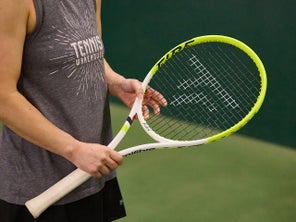
Jason appreciated the easy handling of the Fire 300, but he also wanted a little more stability against heavier shots. He described, "I liked that the Fire 300 was nice and maneuverable, so I could quickly position it to hit a volley. Along those same lines, hitting overheads was pretty easy as well. Where I felt this racquet fell short was with its torsional stability, which resulted in it being pushed around against bigger hitters."
Like Jason, the upsides for Brittany were tied to maneuverability and the downsides to stability. She said, "I loved how fast my reaction time was when I was hitting volleys, and how quickly I could move the Fire 300 into position for a reflex volley exchange. It was also easy to punch volleys deep, but I did make sure to give an extra squeeze to reinforce the racquet. Unfortunately, I wasn't the biggest fan of the feel. It is definitely on the firm side, which you can especially feel outside the sweetspot, and I felt some vibration."
Serves: 8.5
The majority of our playtest team agreed that the serve was a standout category for the Fire 300. Our playtesters appreciated the high serving percentage they achieved with this racquet, and most of them noted an uptick in overall pop. However, Brittany found herself starting in a more defensive position than she's accustomed to when serving. She explained, "I felt comfortable hitting a wide range of spins and targets on my first serve, from slices out wide to flat serves down the T. I also felt I could be pretty concise with the serve. However, I will say that nothing special stood out. I wasn't hitting my biggest serves, and it was more of just a way to start off the point versus trying to win a few extra free points. Second serves were consistent, but they weren't the heaviest, so I was definitely starting in a more defensive or neutral position."
Opting to spin more of his serves in, Jason was not only dropping serves on a dime, but also reducing his double faults, making his serves more effective across the board. He said, "I served at a really high percentage with this racquet, which is huge for me because it kept my double faults down. I was able to generate a lot of spin, so I felt confident that my bigger serves would drop in as long as I shaped them with spin. Power-wise, the Fire 300 felt slightly above average compared to other racquets with similar specs."
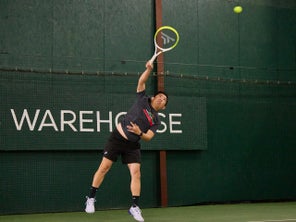
Tiffani found herself cranking up the heat on serve with the Fire 300, fully trusting the racquet to do what she asked of it. She described, "I was quite impressed with the speed I could get on my serves. This racquet has Babolat Pure Drive-like power on serve, and this was my favorite shot to hit with the Fire 300. I don't often hit kick serves, so I can't comment there, but I could get decent spin on my slice serves. This Fire 300 was comfortable to swing, so I didn't tire out during long service games."
The Fire 300 had a lot to offer Chris on serve, and it gave him more free points and better looks than he's used to. He said, "Serving was a lot of fun with the Fire 300. I was able to put the racquet's inherent power and spin capabilities to good use on both first and second serves. I was hitting big enough first serves to quickly close out points, which isn't the usual case for me. My serves had more bite, and I was seeing more weak returns coming back my way."
Returns: 8.4
The Fire 300's maneuverability proved to be its strong suit on service returns. Chris was able to tap into this quick handling to whip his returns back to their originator with some extra interest. He noted, "Thanks to its light and fast feel, the Fire 300 was very easy to position on returns. The racquet also proved to be very stable considering its easy-to-whip feel. My returns had lots of pace, and I found depth very easy to generate. The ample control had me feeling confident enough to return aggressively, without fear of overhitting. My slice and block returns also worked well with this Fire 300. I was able to find my targets and was often able to neutralize a big serve."
While Tiffani felt comfortable going after her returns, she did notice some firmer sensations when she made contact off center. She explained, "I liked being the aggressor on returns with this Fire 300. I mostly play a defensive game, but I like to take time away from the server by taking returns early if I can. With its quick swing and firm response, I could easily step inside the court to attack on return, my only caveat being that there was a drop-off in comfort outside the sweetspot."
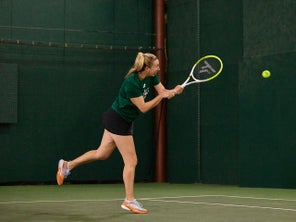
Brittany found found exceptional maneuverability with a little instability at times. She said, "The Fire 300's return is very similar to the rest of the strokes. On one hand, it was easy to get the racquet around my body, and I was never late for the ball. I also felt like I had decent power and placement. On the other hand, it was a bit unstable, especially on first serve returns. I needed to make a conscious effort to really have a good grip to keep the racquet from twisting in my hands."
Jason's returns needed ample spin to be viable for him. He explained, "Being able to hit a return with spin was key for me here. Whether that was a topspin shot or a backhand slice, I needed the spin to keep the ball in the court. When I took bigger cuts and hit a bit flat, I noticed balls were flying on me. I wanted a little more mass in the hoop for stability when I was facing heavier serves, but when I had time to set up and really swing, the Fire 300 delivered solid power, spin and control."
Breakdown Summary
| Groundstrokes | 8.3 |
| Volleys | 8.1 |
| Serves | 8.5 |
| Returns | 8.4 |
| Power | 8.6 |
| Control | 8.3 |
| Maneuverability | 8.9 |
| Stability | 7.9 |
| Comfort | 7.7 |
| Touch / Feel | 7.6 |
| Topspin | 8.8 |
| Slice | 8.2 |
Final Verdict |
8.2 |
Tech Specs
| Length | 27 in |
| Head Size | 100 sq in |
| Weight | 11.2 oz |
| Balance Point | 13 in |
| Construction | 24.5mm / 25mm / 24.5mm |
| String Pattern | 16 x 19 |
| Length | 68.58 cm |
| Head Size | 645.16 sq cm |
| Weight | 318 g |
| Balance Point | 33.02 cm |
| Construction | 24.5mm / 25mm / 24.5mm |
| String Pattern | 16 x 19 |
Tennis Warehouse University Lab Data
| Score | Grade | |
| Flex Rating | 69 | HIGH |
| Swing Weight | 318 | LOW |
Playtester Thoughts

Tiffani
This Fire 300 is more powerful than other racquets in Tecnifibre's lineup. The closest might be the TFight 300, but this Fire 300 is definitely more powerful than that racquet. I would put this up against the Dunlop FX 500, which has a higher launch angle, but it offers similar levels of power and spin. I'd also consider the Babolat Pure Drive, Pure Aero or Yonex VCORE 100.
The Fire 300 is powerful but controllable, even with my flatter strokes. It's an easy-to-use racquet.
I prefer softer racquets, and this Fire 300 feels unstable on off-center shots.
| Tiffani's Breakdown | |
| Groundstrokes | 8.3 |
| Volleys | 8 |
| Serves | 8.6 |
| Returns | 8.3 |
| Power | 8.5 |
| Control | 8.2 |
| Maneuverability | 8.5 |
| Stability | 7.8 |
| Comfort | 7.4 |
| Touch / Feel | 7.8 |
| Topspin | 8.5 |
| Slice | 8.1 |
| Overall | 8 |

Chris
I found the Fire 300 to be much improved compared to the previous Tecnifibre power racquet, the TF-X1. I can control the power much better with the Fire 300, and I found it easier to get the ball to arc over the net and drop well inside the lines. The Fire 300 offers more power and stability than my TFight 300 but is not as much to my liking in feel. If you're looking to demo this Fire 300 against a couple of other power racquets, I'd include the Prince Ripstick 100 300g and a Babolat Pure Drive.
Power! When combined with the spin that I’m able to generate, the power of this racquet enables me to hit a heavy ball. I found the Fire 300 to be surprisingly stable for such a light and fast-feeling racquet.
Not a fan of the feel of the X-Damp handle dampening. To me it feels hollow, and I don't feel as connected to my shots as I do with my TFight 300.
| Chris's Breakdown | |
| Groundstrokes | 8.5 |
| Volleys | 8.5 |
| Serves | 8.6 |
| Returns | 8.6 |
| Power | 8.7 |
| Control | 8.3 |
| Maneuverability | 8.9 |
| Stability | 8.3 |
| Comfort | 8.3 |
| Touch / Feel | 7.6 |
| Topspin | 8.7 |
| Slice | 8.5 |
| Overall | 8.6 |

Brittany
Honestly, there isn't any racquet that really sticks out as playing similarly. There are some that have similar specs, but they have different overall playability, like the Head Extreme MP. I would say the Volkl Vostra V8 300 or an older Wilson Burn 100 would be the closest.
The Fire 300 is very easy to use, with great maneuverability and spin potential.
I am not the biggest fan of the feel; it is a little firm and buzzy at times.
| Brittany's Breakdown | |
| Groundstrokes | 8 |
| Volleys | 7.8 |
| Serves | 8 |
| Returns | 8.1 |
| Power | 8.4 |
| Control | 8 |
| Maneuverability | 8.8 |
| Stability | 7.2 |
| Comfort | 6.8 |
| Touch / Feel | 6.5 |
| Topspin | 8.8 |
| Slice | 8.4 |
| Overall | 8 |

Jason
The Fire 300's performance really reminds me a lot of the discontinued Tecnifibre TF-X1 300 from four years ago. Comparing it to a racquet that is still available, I'd give it a comp to the Prince Ripcord 100.
User-friendly and maneuverable. Great access to spin.
Firmer, crisper feel that is a bit harsh on off-center shots. It can get pushed around.
| Jason's Breakdown | |
| Groundstrokes | 8.4 |
| Volleys | 8.1 |
| Serves | 8.6 |
| Returns | 8.5 |
| Power | 8.7 |
| Control | 8.6 |
| Maneuverability | 9.3 |
| Stability | 8.1 |
| Comfort | 8.2 |
| Touch / Feel | 8.4 |
| Topspin | 9.2 |
| Slice | 8.4 |
| Overall | 8.4 |