Tecnifibre ATP TFight 315 XTC Racquet Review
| Groundstrokes | 81 |
|---|---|
| Volleys | 83 |
| Serves | 81 |
| Returns | 81 |
| Power | 84 |
| Control | 79 |
| Maneuverability | 88 |
| Stability | 79 |
| Comfort | 85 |
| Touch/Feel | 85 |
| Topspin | 85 |
| Slice | 82 |
Packed with power and feel, the Tecnifibre ATP TFight 315 XTC proved to be a great weapon for aggressive play! Updated with Xtreme Touch Construction, the TFight 315 has been redesigned to improve flexibility, touch and stability. With a low swingweight of 314 RDC and an open 16x19 string pattern, this racquet swings fast and loads the ball with spin, making it more user-friendly than the typical modern player's racquet in this weight category. Our playtesters appreciated the easy-to-use nature of the racquet and enjoyed cranking up the pace on groundstrokes. Up at net, maneuverability was met with great touch, which helped several playtesters dictate play, although some were disappointed when they found less stability than they expected for a racquet of its weight. There were positives across the board when it came to serves — easy power, spin and precision were resounding themes. Whether returning first or second serves, many playtesters found it easy to dial in their timing and switch up their returns from offensive to defensive, although one playtester struggled with handling heavy pace. All of our playtesters tested this racquet side by side with the TFight 300 XTC, and preference of one over the other differed among the playtesters. Both racquets were super maneuverable and spin friendly, but they varied a bit in feel and playability. We definitely recommend taking both racquets out for a test drive to see which one best fits your game!
Upsides
- Maneuverability
- Power
- Spin-friendly
Downsides
- Lacked some stability
Bottom Line
This racquet swings surprisingly fast for is weight, which translated into plenty of spin and versatility.
Ability
Intermediate to advanced
Groundstrokes - Score: 81
With a low swingweight of 314, this ATP TFight 315 XTC swung fast for our playtesters, who found effortless access to spin. Kristen quickly found her groove on groundstrokes. She explained, "From the first hit with this racquet, I was impressed with its comfortable nature. It definitely played plusher than the TFight 300 XTC, and it was super maneuverable for a racquet with a static weight of 315 grams. Since I meshed with the feel of this racquet more than I did with the 300 model, I was able to get more dialed in on my shots and find better control, as well as find my targets more easily. My only qualm was that during point situations I did find I was missing a bit of plow through at times. With such a low swingweight, I think there's some room for customization to help in that category."
Finding some inconsistencies from the baseline, Sean tried changing up his game style to best tap into the ATP TFight 315 XTC's strengths. He stated, "Despite weighing 315 grams, the TFight 315 swung noticeably quicker than its weight might suggest. I found the launch angle to be fairly high, and when combined with the whippy balance, it produced a heavy ball from the baseline. The downside was that although there was plenty of power, the response lacked stability, and I frequently lost control. I feel I played better when I changed my mindset from being a counterpuncher to being an aggressive baseliner."
Tiffani was pleased with the performance of the ATP TFight 315 XTC, and she found no problems handling the weight of the frame. She said, "The last TFight 315 version I tested was the Dynacore, and since then I've adopted a slightly heavier go-to racquet (now playing with a Prince Textreme Tour 100P vs the Babolat Pure Drive), so I felt more comfortable from the get-go with a racquet at this weight. This TFight 315 XTC also has quite a low swingweight, and it felt whippier than expected. I was hitting with more spin than I was with the TFight 300, according to my PlaySight data, which I didn't expect going into this playtest. I liked this racquet from the baseline for its easy pick-up-and-go playability, which I don't always find with racquets at this weight."
Erik appreciated the generous access to spin, but he was missing the more controlled response he found with the TFight 300. He stated, "This racquet felt more powerful than the TFight 300 XTC, but also less controlled. I was able to get great access to spin, though. I found my slices were staying low, and I was able to place them strategically thanks to the excellent feel. This really benefited my game style of chipping and coming into net. With its lower swingweight, this racquet was extremely maneuverable and felt stable on contact."
Volleys - Score: 83
The TFight 315 XTC provided our playtesters with great feel, and it let them react quickly when they were at the net. Erik was able to keep his opponents at bay by mixing up his net-game strategy. He articulated, "This racquet was very maneuverable up at net, and like the 300 gram model, the feel was exceptional. I could pin my opponent deep with a floating volley and carve out drop volleys with lots of spin. I was also able to change it up and hit some short angled volleys. Overall, I felt extremely connected to the ball at net."
Volleying was the highlight of the playtest for Tiffani. She explained, "This was my favorite shot with the TFight 315 XTC. I thought this racquet played surprisingly fast for its weight, but it also had a comfortable feel. It blended the mobility of a lighter racquet with some of the benefits of a heavier spec. This racquet felt plusher in the sweetspot than the lighter TFight 300 XTC."
Though Kristen loved the plush feel, she thought the racquet got pushed around a bit at net. She noted, "Up at net that light maneuverability was super beneficial for getting great reaction time. I was getting great touch and a nice, controlled response. However, the torsional stability did start to waver a bit against big hitters."
Sean also had some issues up at net. He explained, "I found the lack of stability to be frustrating at net, where I was looking for a more solid response. I thought the touch was all right, but I struggled blocking back pace and volleying from the midcourt, where I could feel the racquet twisting in my hand."
Serves - Score: 81
Power, spin and precision made serving a standout portion of the ATP TFight 315 XTC playtest. Sean was pleased that some of the stability issues he experienced on groundstrokes and volleys didn't carry over to serves. He noted, "I liked the pace and spin I could generate on my serve. The theme of consistency being an issue wasn't as prevalent here. When I was generating my own pace I didn't feel the instability of the racquet as much. This was one of my favorite parts of the playtest."
Erik reveled in the many positives. He affirmed, "The power on my first serves was fantastic. I felt like I could bomb first serves and accurately place them with a good amount of control. The control on my second serve was also very solid. I felt like I could place serves wherever I wanted with a significant amount of spin. Therefore, I felt confident serving with this racquet and in my ability to accurately hit my targets. My favorite serve was the T serve."
Kristen was able to vary her serve with ease, and she found good power. She said, "This racquet felt really solid on serves. I found I could really crank up the pace thanks to its fast-swinging nature. I could mix up my serves well and get great precision."
Although it took Tiffani some time to get into her groove on serves, she was ultimately pleased with the racquet's performance. She explained, "I was surprised to find that it was a bit harder to initiate my swing on serves with this racquet, especially considering how quickly I could swing it on my groundstrokes. Once I got this racquet moving, it felt smooth. It just took me a while to get adjusted. I wasn't moving the ball around the service box as easily as I can with lighter racquets, but I could hit my serves with decent power and spin."
Returns - Score: 81
Timing was a key positive when returning with the ATP TFight 315 XTC. Whether they were counteracting heavy pace or dictating play with an aggressive return, most of our playstesters found success, although somed had a tendency to overhit. Tiffani was happy to experience the same user-friendly nature she found from the baseline. She said, "Just like my experience when I was hitting groundstrokes, I was pleasantly surprised at how easy it was to wield this TFight 315 XTC on returns. It came around quickly so I wasn't getting caught late like I would expect with a racquet weighing 11.7 ounces strung. Similar to how I felt with the TFight 300 XTC, I thought trying to add some spin, which I normally wouldn't do on my returns, was my best bet with the TFight 315. When I missed with this racquet I tended to send the ball long."
Similarly, Erik was pleased with the ATP TFight 315 XTC's performance, but he noticed some errors creeping up on him when he wasn't careful. He said, "On returns, I was able to get the ball back in the court aggressively or conservatively. I like to chip my returns, and I felt like I could get great depth when I did. There was easy access to power on returns, and sometimes I felt like I had to hold back or else I would spray the ball long. When returning first serves, it was easy to redirect the server's pace when I was returning first serves. On second serves, it was easy to take control of the point if I decided to. The TFight 315 XTC was quite maneuverable, and it was very easy to get it around my body. It also felt very solid in my hand at contact."
Sean had some trouble handling pace on returns. He noted,"Like at net, I struggled to find a consistent way to absorb power. I think maybe too much of the ATP TFight 315 XTC's weight was distributed toward the handle. Returning second serves was much easier, since I had more time to take a full swing and generate my own pace."
Kristen relished the comfortable feel and great timing she experienced on returns. She elaborated, "I enjoyed returning with this racquet, and I liked the nice pocketing it offered. It was really easy to get my timing right thanks to the maneuverability. When I was pushed out wide it was easy to get around the ball and create some really great angles off the return, and when I was up against heavier servers it was easy to react quickly and slice the ball back into the court."
Overall - Score: 81
| Technical Specifications | ||
|---|---|---|
| Length | 27 in | 69 cm |
| Head Size | 98 sq in | 632 sq cm |
| Weight | 11.7 oz | 332 gm |
| Balance Point | 12.59 in 32 cm | 7pts Head Light |
| Construction | 22.5mm/22.5mm/21.5mm | |
| Composition | Dynacore HD/Graphite | |
| String Pattern | 16 Mains / 19 Crosses | |
| Babolat RDC Ratings | ||
|---|---|---|
| Score | Grade | |
| Flex Rating | 68 | Range: 0-100 |
| Swing Weight | 314 | Range: 200-400 |
Scores
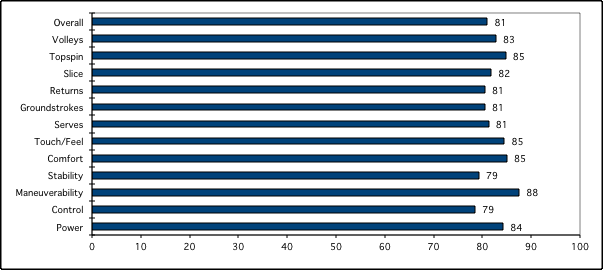
(Scores are determined by averaging individual play test scores)
| Sean's Scores | |||
|---|---|---|---|
| Power | 8.7 | Serves | 8.5 |
| Control | 7.4 | Groundstrokes | 8.3 |
| Maneuverability | 9 | Returns | 7.6 |
| Stability | 7.1 | Slice | 8.3 |
| Comfort | 8 | Topspin | 8.9 |
| Touch/Feel | 8.1 | Volleys | 7.7 |
| Overall | 7.6 | ||
| Tiffani's Scores | |||
|---|---|---|---|
| Power | 8 | Serves | 8.1 |
| Control | 7.9 | Groundstrokes | 8.3 |
| Maneuverability | 8.5 | Returns | 8 |
| Stability | 8 | Slice | 8 |
| Comfort | 8.1 | Topspin | 8.4 |
| Touch/Feel | 8.1 | Volleys | 8.1 |
| Overall | 8 | ||
| Kristen's Scores | |||
|---|---|---|---|
| Power | 8.5 | Serves | 8.4 |
| Control | 8.3 | Groundstrokes | 8.6 |
| Maneuverability | 9 | Returns | 8.4 |
| Stability | 8.2 | Slice | 7.9 |
| Comfort | 8.9 | Topspin | 8.6 |
| Touch/Feel | 8.6 | Volleys | 8.5 |
| Overall | 8.5 | ||
| Erik's Scores | |||
|---|---|---|---|
| Power | 8.5 | Serves | 7.5 |
| Control | 7.8 | Groundstrokes | 7 |
| Maneuverability | 8.5 | Returns | 8.2 |
| Stability | 8.4 | Slice | 8.5 |
| Comfort | 9 | Topspin | 8 |
| Touch/Feel | 9 | Volleys | 8.8 |
| Overall | 8.3 | ||
Playtester Profiles
Sean: Open level counterpuncher with a semi-western forehand and a two-handed backhand. He currently plays with the Yonex VCORE Pro 97 (310).
Tiffani: 4.0 level baseliner with a semi-western grip on the forehand and hits a two-handed backhand. Currently playing with the Prince Textreme Tour 100P.
Kristen: 5.0 level player with a semi-western forehand and a two handed backhand. Kristen currently plays with a Prince Phantom Pro 100.
Erik: Open level all court player with a one-handed backhand and a western forehand. He is currently using the Yonex EZONE 98.




Likes
Sean- "The ATP TFight 315 XTC provided easy spin and power, and I enjoyed playing on my own terms from the baseline and on serve."
Kristen- "I love the maneuverable, plush nature of the ATP TFight 315 XTC."
Tiffani- "It felt surprisingly maneuverable for a racquet at its weight."
Erik- "I enjoyed the maneuverability and feel."
Dislikes
Sean- "The swingweight reflects the problems I had with the stability of the ATP TFight 315 XTC; I prefer a frame with a more even balance."
Kristen- "I felt it lacked a bit of plow through and stability when under pressure in point situations."
Tiffani- "I really didn't have many. Nothing stood out as a strong negative. However, in tight situations, I found the TFight 300 XTC to be a little easier to play with. I found the lighter version a bit easier to build points with because I felt a little more under control."
Erik- "This racquet lacked a bit of control from the baseline."
Comparing the racquet to others they've tried, our testers said:
Sean- "I didn't hit with the previous version, but I was definitely reminded of the Head Graphene 360 Speed MP with the TFight 315 XTC's whippy nature."
Kristen- "Overall, I found this model to be a more comfortable, plusher option than the TFight 300 XTC. While the specs vary a bit from my current racquet of choice (Prince Phantom Pro 100), the ATP TFight 315 XTC possesses similar feel, maneuverability and spin potential, which are the attributes that led me to my Prince."
Tiffani- "I typically play with racquets that are a bit lighter, but the swingweight on the ATP TFight 315 XTC is low enough to make it playable for me. It actually swings as easily (if not quicker) as the TFight 300 XTC. I remember thinking that the Dynacore version of this racquet felt just a bit out of reach, but this racquet felt more than manageable and opens an opportunity for players who typically use racquets weighing in the low 11 ounce range to try something a little bit heavier."
Erik- "I preferred the Tecnifibre ATP TFight 300 XTC racquet over this ATP TFight 315 XTC because the 300 offered a bit more control, and I could construct my points more effectively. Comparing this racquet to my Babolat Pure Strike VS, I found the ATP TFight 315 XTC to have a little more plow through and a bit more feel. The 16x19 string pattern also creates a higher trajectory off the stringbed, allowing for deeper, more penetrating shots. The Wilson Pro Staff 97 also played similarly to this racquet."