ProKennex Ki Q+ Tour Pro (305g) 18x20 Racquet Review
Summary
The ProKennex Ki Q+ Tour series features both a 16x19 and 18x20 model, and in this review Oak and Mark discuss the 18x20 version. This review is for the ProKennex Ki Q+ Tour Pro (305g) 18x20, but you can read the 16x19 review here. The big change for the Ki Q+ Tour Pro is the unstrung weight being reduced from 320 grams to 305 grams, which is becoming an increasingly popular baseline spec. Otherwise, the tried-and-true Kinetic chambers within the racquet sport ProKennex's signature movable mass, which boosts comfort substantially. Although this racquet was on the lower end of the power spectrum, it garnered high praise for its inherent comfort and reliable control. Overall, the ProKennex Ki Q+ Tour Pro (305g) 18x20 should be considered by players looking for a control frame in the 305-gram, 98-square-inch head-size range that provides more comfort than some of its competitors.
- Comfortable without compromising on other areas
- Excellent control and maneuverability
- Individual dislikes varied
Final Verdict
Breakdown
Groundstrokes: 8.4
Although the ProKennex Ki Q+ Tour Pro (305g) 18x20 was on the lower end of the power scale, the racquet's massive comfort, reliable feel and control-oriented nature shone through for our two testers, who both play a counterpunching game. Mark reveled in this racquet's inherent spin and control, and he was able to hit a variety of groundstrokes with ease. He explained, "I could feel the mass-based power and the high degree of control coming from its softer layup of graphite. As a result, my groundstrokes had a lot of variety, good consistency and decent power. The Ki Q+ Tour Pro (305g) 18x20's strung mid-320 swingweight, 7-points head-light balance and 305-gram unstrung weight gave me just enough maneuverability, along with plenty of stability, to fend off heavy shots offensively or defensively. My forehand cross-court shots were particularly tough to deal with. As expected, the launch angle of the 18x20 pattern was low, which provided a very connected feel to all of my groundstrokes and benefited my backhand slice. When paired with a thinner polyester, this racquet could generate a tight topspin rotation on the ball that didn’t bounce up high on my opponent's side of the court."

Oak enjoyed the comfort and control afforded to him by the Ki Q+ Tour Pro (305g) 18x20, and he praised its versatile nature. He said, "ProKennex frames have a soft spot in my heart and in my hand when playing. Their overall comfort is pretty much always a joy to work with, and I like their more control-oriented frames for their blend of plushness and precision. The Ki Q+ Tour Pro (305g) 18x20 has good spin production and decent pop, and I felt comfortable with all of my groundstrokes. I thought the depth of my slices was pretty good, but I found myself wishing for a lower trajectory when slicing. It feels like the racquet actually sits very nicely in the middle between control and power. There was good stability and enough maneuverability, and it was really easy to prepare for my shots. For my style of play (which these days is somewhere between counterpunching when at the baseline and serve-and-volley), the Ki Q+ Tour Pro worked mostly well in singles but really shone for me in doubles."
Volleys: 8.6
Up at net, the Ki Q+ Tour Pro (305g) 18x20 proved both precise and practical for absorbing pace. Oak loved volleying with this racquet and was comfortable being craftier with his placement. He said, "ProKennex frames tend to play really well for me at net. The movable mass within the frame absorbs incoming pace extremely well, and I like how the racquet lets me shape the ball throughout contact. I was hitting a nice variety of volleys, and I was really leaning into trying to wrong-foot my opponents since I could 'hold' onto the ball just a little longer through contact. I felt mostly connected to the ball, although the feel was somewhat muted given the flex and the movable mass."
"Perhaps what I liked most was the connected feel and the extended dwell time the racquet afforded me, which put me in command of where my volleys were landing."
Although Mark wouldn't call the Ki Q+ Tour Pro (305g) 18x20 speedy at net, he appreciated the extra dwell time for shaping his volleys. He said, "As with my groundstrokes, I wouldn’t say the Ki Q+ Tour Pro was quick at net, but it was quick enough. On the flip side, the level of stability and the predictability of this racquet made it easy for me to hit everything from offensive topspin volleys to butterfly kissing half volleys into the open court."
Serves: 8.4
Our two testers found good precision and excellent comfort when serving with the Ki Q+ Tour Pro (305g) 18x20, and these traits allowed them to attack with ease. Oak felt that the Kinetic technology boosted his experience on serve. He said, "Serving with more flexible frames and thinner beams can be tough for me sometimes. I typically like a thicker beam on serve and/or some additional mass. Thankfully, the movable mass within the frame helped me out a lot here. My favorite serve, as usual, was up the T on the ad side."
"I liked being able to ratchet up the pace if desired, and thankfully, I felt like I got good enough spin to shape my serves with emphasis."
Mark also found excellent all-around capability from the Ki Q+ Tour Pro (305g) 18x20 on serve. He said, "I play with similar racquets, and I have to say that it was very easy for me to serve with the Ki Q+ Tour Pro. My serve speed and rotation on the ball did not change much, but my serves were consistent and effective enough to prevent my opponents from attacking off their returns.”
Returns: 7.9
Returning serves with the Ki Q+ Tour Pro (305g) 18x20 was characterized by plenty of comfort and reliable control. Mark found good directional capabilities, and his backhand in particular was sending serves back with additional venom. He explained, "In general, I had good directional control of my return of serve, and chipping or slicing that shot back into play worked well. However, two of the more successful shots I was hitting with the new Ki Q+ Tour Pro (305g) 18x20 were my topspin backhand return up the line and my cross-court return from the deuce side."
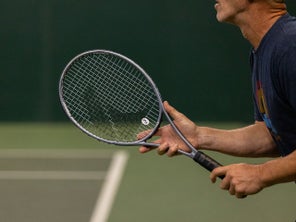
The return was Oak’s least favorite shot to hit with the Ki Q+ Tour Pro (305g) 18x20. He said, "Returns were OK. I sometimes wanted the racquet to release the ball out of the stringbed more quickly, but that's me being nit-picky, and I get how that'd be mostly unrealistic with the racquet's design. I liked the deeper pocketing on pretty much everything but my returns, so I'm ultimately OK with that trade-off. The Ki Q+ Tour Pro absorbs pace well, but redirecting it isn't as conducive for me against first serves. Thankfully, my experience was a little bit better against second serves."
Breakdown Summary
| Groundstrokes | 8.4 |
| Volleys | 8.6 |
| Serves | 8.4 |
| Returns | 7.9 |
| Power | 7.9 |
| Control | 8.4 |
| Maneuverability | 8.2 |
| Stability | 8.3 |
| Comfort | 8.5 |
| Touch / Feel | 8.3 |
| Topspin | 8.3 |
| Slice | 8.4 |
Final Verdict |
8.3 |
Tennis Warehouse University Lab Data
| Score | Grade | |
| Flex Rating | 61 | LOW |
| Swing Weight | 324 | MED |
Playtester Thoughts

Mark
The Babolat Pure Strike 98 18x20, Tecnifibre TF40 305g (18x20), Dunlop CX 200 (18x20) Limited Edition, Solinco Whiteout 305 18x20 and Wilson Blade 98 v10 18x20 all have pretty similar specs. I would say the Pure Strike and Blade are the most similar in terms of feel and performance.
Compared to other 98-square-inch, 305-gram frames with an 18-main pattern, the Ki Q+ Tour Pro (305g) 18x20 delivers a unique feel (and to a degree sound as well) that is hard to describe, but it's a huge positive for me. In terms of balance, stiffness and string spacing, the overall design complements my singles and doubles game. In addition, I like ProKennex's choice of a silver cosmetic, which is distinctive yet business like.
Zero gripes from me. The ProKennex Ki Q+ Tour Pro (305g) 18x20 is a versatile all-court performer.
| Mark's Breakdown | |
| Groundstrokes | 8.3 |
| Volleys | 8.3 |
| Serves | 8.3 |
| Returns | 8 |
| Power | 7.5 |
| Control | 8.5 |
| Maneuverability | 8 |
| Stability | 8 |
| Comfort | 8 |
| Touch / Feel | 8 |
| Topspin | 8 |
| Slice | 8.5 |
| Overall | 8.2 |

Oak
Being 15 grams lighter makes this Ki Q+ Tour Pro (305g) 18x20 an interesting departure from its predecessor. This version feels much more accessible and remains a good option for platforming up to a heavier spec. I feel like this is such an overlooked family of racquets, and both this 18x20 and the Ki Q+ Tour (305g) 16x19 should be on the demo list of anyone who struggles with more serious arm/wrist/shoulder issues. They are just that comfortable. I'd demo this alongside a Wilson Blade 98 v10 18x20, a Babolat Pure Strike 98 18x20 and a Dunlop CX 200 Tour 18x20.
I really liked the comfort I found with the Ki Q+ Tour Pro (305g) 18x20, which let me go after bigger shots without fear of aggravating my arm at all. I also enjoyed the Ki Q+ Tour Pro a ton at the net.
I struggle a bit on returns with this racquet, and it is the one area where I actually want the racquet to release the ball from the stringbed more quickly.
| Oak's Breakdown | |
| Groundstrokes | 8.4 |
| Volleys | 8.8 |
| Serves | 8.5 |
| Returns | 7.5 |
| Power | 8.2 |
| Control | 8.3 |
| Maneuverability | 8.4 |
| Stability | 8.5 |
| Comfort | 8.9 |
| Touch / Feel | 8.5 |
| Topspin | 8.5 |
| Slice | 8.3 |
| Overall | 8.4 |