Gear Guides - Tennis Racquets
Why Customize Your Racquet?

Customizing your tennis racquet may sound intimidating if you've never done it or tried. But our experts are here to keep it simple and answer any questions you might have about customization. We talk about it all!
Players have a variety of reasons they want to customize their tennis racquets. You can customize racquets to add more power and more stability, for example. Some players also want all of their racquets in their bag to "match" in terms of specs, and because of variances in the manufacturing process, racquets usually aren't exactly the same. Whatever the reason you are considering customizing your racquets, our racquet experts are here to offer some guidance.
We offer racquet matching and customization services for small additional fees. When 2-3 racquets are being matched to each other, there is a $20 matching fee applied per order. These racquets will be as close as possible to each other in static weight, balance point and swingweight.
Matching racquets to a specific target spec (i.e. lightest possible, lowest swingweight, specific weight/balance point) will require additional materials added to the frames and will result in a $30 customization fee per racquet. We will have a certified Master Racquet Technician carefully alter your racquets to your requested specifications and email you with the results. The additional MRT costs are non-refundable labor fees.
The customization methods we use are reversible. If you add TW customization tape to your racquet, and you don't like it, you can simply remove it.
For more information regarding Tennis Warehouse racquet customization fees or racquet matching service details, please contact our Racquet Specialists at 1-800-799-9230 or email racquets@tennis-warehouse.com
If you'd like to customize your own racquets, there are some basic terms you should know as well as some tools you'll need to have on hand before getting started.
The total mass of the racquet is referred to as static weight.
The balance point relates to where the majority of the racquet's weight is situated. Head-light racquets have more weight in the handle. Head-heavy racquets have more weight in the head.
Swingweight is a measurement of how heavy a racquet feels when you swing it. Racquets with higher swingweights are harder to swing, but they offer more comfort, power and stability at impact. Racquets with lower swingweights are easier to swing, but they offer less stability and comfort, espeically when playing against higher levels of pace.
When working with swingweight in customization, the static weight, balance point and where weight is added have cause-and-effect relationships.
It's important to note that swingweight cannot be effectively reduced from a frame. The only way swingweight can be reduced is to trim the bumper guard or shorten the length of the frame, neither of which is practical. However, varying string gauge and string type can affect a racquet's swingweight.

You may also find these tools handy:

When we talk about adding weight to the racquet's hoop, we usually refer to points on the racquet in terms of a clock face. As demonstrated at left, 12 o'clock would be the tip, 6 o'clock would be at the bridge and so on.
We prefer to use TW Tungsten Tape because it is lead free. It's packaged in lengths of 8-inch strips (1 strip = 2.8 grams / 0.1 oz). At least initially, we recommend adding customization tape to the inner hoop rather than under the bumper guard, which requires you to cut out the strings. When applying tape to the inner hoop of the racquet, it should be placed as closely to the grommets as possible.
In our video example above, we add one strip of TW Tungsten Tape, cutting it into two 4-inch strips and placing it at 12 o'clock. By adding the one strip we:

In our example image above, we have added one strip of TW Tungsten Tape, cutting it into four 2-inch strips and placing it at 10 and 2 o'clock. This not only makes the racquet heavier, but it also helps reduce frame-twisting on off-center hits. By adding a single strip at 10 and 2, we:
We don't recommend adding weight in the upper hoop of head-heavy racquets unless counter-balancing it with weight to the handle.
In our video example above, we have added two strips of TW Tungsten Tape, placing it at 3 and 9 o'clock. This not only makes the racquet heavier, but it also helps reduce frame-twisting on off-center hits. By adding two strips at 3 and 9, we:
To make a racquet swing heavier without substantially increasing overall weight, you can add two 2- to 3-inch strips of TW tungsten tape to the inner hoop of the racquet's tip. This will result in a 5- to 7-point swingweight increase.

If you want to increase the racquet's total mass without changing the balance point, apply the TW customization tape to the inner area of the throat of the racquet. This will preserve the balance point of most racquets while increasing the racquet's total mass with only a slight increase to the swingweight.
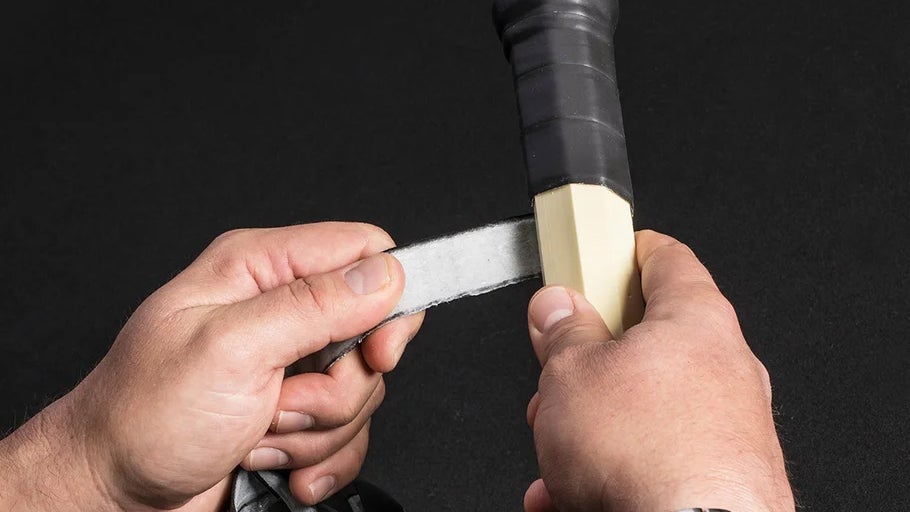
Making a racquet more head light allows the player to enjoy the benefits of added weight without compromising the maneuverability. Simply replacing a synthetic stock grip with a leather grip, which is heavier, is an easy way to achieve this. Leather grips vary in weight but can weigh anywhere from about 6 to 11 grams (0.2 oz to 0.4 oz) more than a synthetic grip. As far as the effect on balance point, the leather grip versus synthetic grip variance is roughly equivalent to:
Another way to achieve this is through tail-weighting. This is fairly easy to do on racquets with trap door access through the butt cap. The staples protruding inside the handle (that hold the butt cap in place) can be used to anchor cotton balls in place. This provides a platform to pack in tungsten putty, seal it with glue and press the trap door back into place.

Racquet handles without trap door access
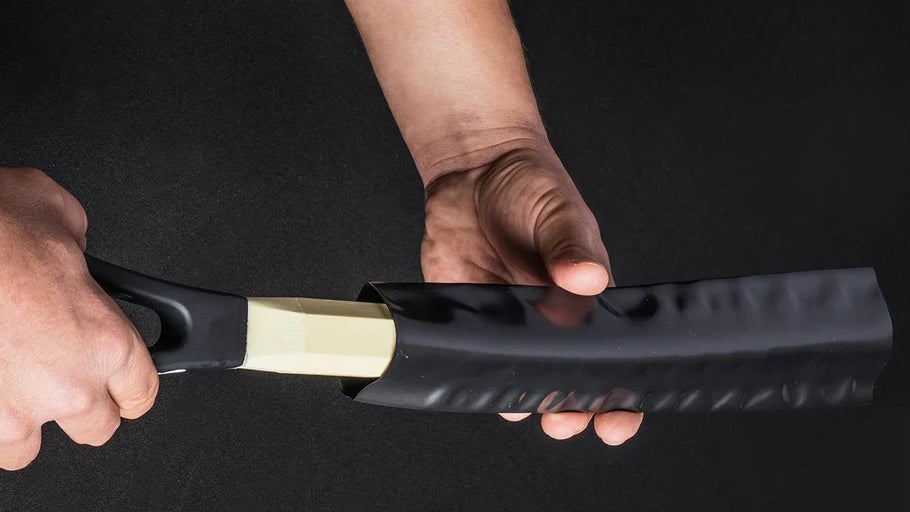
Some racquets' design prevents weight from being added inside the handle. In these cases, we've found going down a full grip size and adding a heat shrink sleeve is an effective and inexpensive way to tail-weight. Shrink sleeves increase the grip size one full size and add 17 grams (0.6 oz), translating into 3 points more head-light balance (and a couple points higher on swingweight points).

The automated racquet customization tool on Tennis Warehouse University is great for exploring possibilities. Once you plug in the "what I have" specs and the "what I want" specs, click customize my racquet and a diagram of weight placement options will pop up. If the specs you want aren't possible, the customization tool will let you know.