Wilson Hammer 6.2 Oversize
June 1994
Frame Specifications
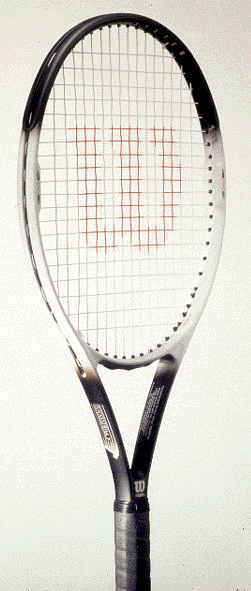
The 6.2 has a not-bad-loooking black and white matte finish with gold trim and lettering. It sports a slightly more oval head shape than its Hammer predecessors, the oval head and wider shaft looking more like a Spalding Orbi-Tech frame than the egg-shaped designs on previous Hammer models. A Cushion-Aire Sponge grip adorns this frame, with very large air holes, topped off with a solid bumper guard (See Fine Points).
The 6.2 has the ubiquitous Wilson Dual Taper Beam design, measuring 23mm at top head, 26mm at center head (just below the PWS), expanding to 28mm at the shoulders, and down to 25mm at the handle. Beam thickness is 12mm, with a moderate flex of 38. Our test model had unstrung weight of 290 grams (9.6 oz), with Hammer weighting providing a balance point of 383mm from the handle (15 1/8 in.), or an astonishing 13 points head heavy. This extreme balance point should make for interesting swinging once we get it out on the court.
Hammer 6.2si in Play
The extreme balance point was evident from the first hit, as the 6.2 had ample power from the baseline, combined with good depth. The softer flex actually gave us some feel, believe it or not - something we're not used to having with Dual Taper Beam frames.
The head weight also meant that we couldn't take a big swing at the ball without mis-hitting almost everything. Snapping the head up for topspin shots was also a chore, although the easier motion on slice shots was not anywhere near as much work.
Serving was really the 6.2's bugaboo with us, as the Hammer weighting made it extremely difficult to do much of anything with any type of serve, with kick serves being the most trouble. If we could get it moving fast enough, power production on flat serves was more than adequate, but a couple of hours of play made the arm tired. Shot production on overheads suffered a similar fate.
Volleying was adequate at best, the head weighting giving good stability and power, but hampering maneuverability of the frame during fast exchanges. the feel we found at the baseline gave us some sense that we were actually involved in the shot, but we'd still like more flex at the net.
Fine Points
The new Cushion-Aire Spopnge grip makes us think of the movie "20,000 Leagues Under the Sea". remember the octopus? That's what we felt like we had our hands on with this grip. The perforations are just huge, allowing lots of sweat to drip through to the lower layers, but giving that "suction cup" feeling to the hand. Disconcerting at first, we started to get used to it as time wore on, but felt hindered on grip changes. Maybe it's just our imaginations, but you know what they say: if you think it is, it is!
The solid bumper guard performed adequately, just like on the other Hammer series frames, with good resistance to the court on low volleys and the like. We didn't make much of a dent in the paint job, as the black coloring on top didn't scrape down much. h2In Conclusion
Wilson's Hammer 6.2si would work best in the hands of the baseline singles player. Too head heavy for net play, it's a poor choice for doubles, and the serving difficulties render it a poor choice for "active" players. If your style of play is to stand back and hang the racquet out to dry, you can take advantage of its power and stability, working very little for the amount of power you get. If you like to swing, look into the more standard weight and balance of the Pro Staff line.
This review is copyrighted by RacqueTech magazine. RacqueTech was one of the few, if not the only, unbiased sources of information on racquet technology. Unfortunately, RacqueTech is no longer being published. If you found this article useful and would like to see more of this type of information available, please drop us a note and we'll do whatever we can to make it happen. Thanks, Tennis Warehouse Staff.